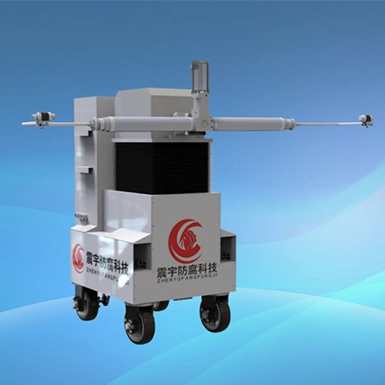
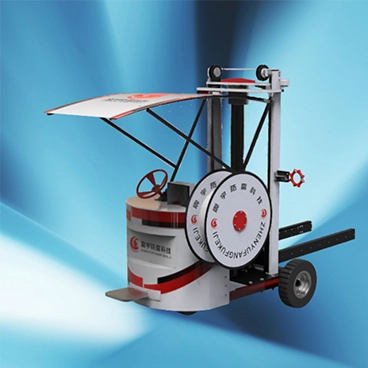
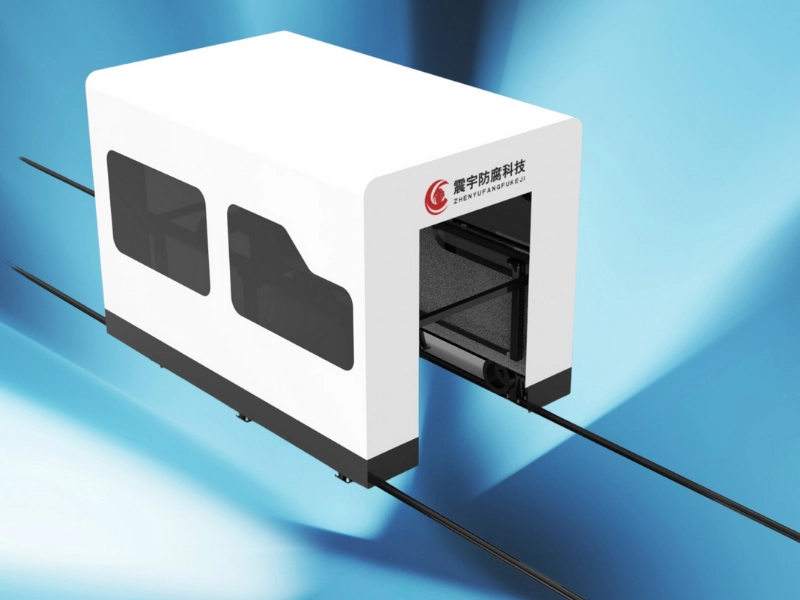
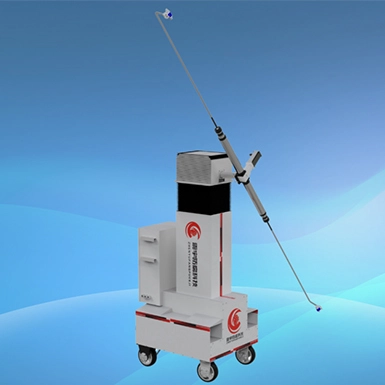
An automatic spray booth is more than an enclosure around spraying equipment. Its airflow, filtration, conveyor movement, paint delivery, control logic, and emission-treatment system must operate as one coordinated process. When these elements are designed separately, the line may experience unstable coating thickness, paint mist escape, surface contamination, excessive energy consumption, or difficult maintenance.
For steel structures and other large industrial components, booth design must also accommodate different profiles, long workpieces, and changing production schedules. ZHENYU develops automatic paint spraying lines that integrate loading and unloading, pretreatment, drying, spraying, curing, PLC control, and filtration according to the customer’s workpieces and coating requirements.
Start with Airflow in an Automatic Spray Booth
Airflow must carry overspray and solvent vapor away from the spraying area without disturbing atomization or depositing dust on the wet coating. Mechanical ventilation should operate during spraying and remain active long enough afterward to remove residual vapors. The required airflow depends on booth configuration, coating properties, opening size, and the spraying operation, so one standard velocity should not be applied to every project.
Common airflow arrangements include crossdraft, downdraft, and semi-downdraft designs. A crossdraft booth moves air horizontally from the intake side toward the exhaust side and can be suitable for long conveyorized workpieces. A downdraft booth introduces clean air from above and extracts contaminated air near floor level, which may improve control around complex components but requires more floor construction and ductwork.
The final arrangement should consider:
Maximum workpiece dimensions
Spray-gun position and movement
Conveyor entrance and exit openings
Coating type and solvent content
Operator and maintenance access
Applicable safety and environmental requirements
Make-up air and exhaust air must remain balanced. Excessive negative pressure can draw unfiltered workshop air into the booth, while insufficient extraction may allow paint mist to escape. OSHA requires mechanical ventilation for spray operations and notes that airflow requirements vary according to booth design and operating conditions.
Plan Automated Spray Booth Filtration Around the Coating Process
An automated spray booth normally needs separate filtration stages for incoming and exhaust air. Intake filters prevent workshop dust from reaching freshly coated surfaces. Exhaust filters capture paint mist before contaminated air enters ductwork or a downstream VOC-control system.
Filter selection should consider coating type, overspray loading, airflow resistance, finish-quality requirements, and expected replacement frequency. A filter may provide high capture efficiency but still cause operating problems if it loads too quickly and restricts airflow. Differential-pressure monitoring can help maintenance teams identify when filters require replacement.
For heavy steel-structure coating, designers may compare dry filters, multi-stage filter media, and wet collection systems. Dry filtration is generally simpler to install and maintain. Wet collection can manage high overspray loading but introduces additional requirements for water treatment, sludge handling, and corrosion control. EPA guidance identifies both dry filters and water-wash systems as methods for removing overspray particles from booth exhaust.
ZHENYU’s automatic paint spraying line uses filtration and centralized paint-mist collection. Its air-circulation arrangement can also connect with a VOC treatment system, allowing particulate capture and vapor treatment to be planned as a complete exhaust process.
Coordinate the Conveyor Layout with the Automated Paint Booth
Conveyor design directly affects throughput, spray access, airflow stability, and coating consistency. The conveyor must move each component at a controlled speed while maintaining sufficient clearance for spray guns, sensors, booth walls, and exhaust airflow.
Before selecting the conveyor, define the maximum workpiece length, width, height, weight, center of gravity, supporting method, spacing between components, and required production rate. Long beams, columns, box sections, circular structures, and irregular fabrications may require different fixtures or positioning strategies.
Booth entrance and exit openings should be only as large as necessary. Oversized openings increase air loss and can disturb pressure balance. Drip trays, removable shields, and protected conveyor drives can reduce paint accumulation and simplify cleaning.
ZHENYU’s digital processing system can retrieve component parameters from 3D models and generate suitable spraying paths. The equipment can also spray upper and lower areas of a component in one operation, reducing secondary turning and the waiting time required before repositioning.
Integrate VOC Control with the Automatic Paint Booth
VOC control should be considered during the initial design of an automatic paint booth, rather than added after installation. The coating formulation, solvent content, paint consumption, exhaust volume, working hours, and local emission limits determine which treatment method is suitable.
Potential technologies include activated-carbon adsorption, thermal oxidation, catalytic oxidation, condensation, or an approved combination of concentration and treatment equipment. Selection depends on VOC concentration, exhaust temperature, humidity, and the presence of contaminants.
Particulate filtration normally comes before VOC treatment because paint mist can foul carbon beds, heat exchangers, catalysts, and sensors. Spray-booth exhaust must also be discharged safely, and contaminated air should not be recirculated unless hazardous substances have been adequately removed.
Reducing unnecessary exhaust volume may lower heating and treatment costs, but airflow must remain sufficient to control mist and vapor safely. Final design must comply with the fire, occupational-safety, and environmental requirements applicable at the installation location.
Size and Commission the Automatic Spray Paint Booth
An automatic spray paint booth should be sized around the workpiece envelope plus the clearance required for gun movement, airflow, conveyor travel, maintenance, doors, and emergency access. A booth that only accommodates the component dimensions may not leave enough space for the correct spray distance or a stable airflow pattern.
The complete line should also account for pretreatment, flash-off, drying, curing, loading, and unloading. When these stages have different cycle times, the slowest process determines overall throughput. Buffer areas may be required to prevent the spraying section from stopping whenever another stage is delayed.
Commissioning should use representative components and the actual coating system. Verify:
Airflow direction and booth pressure
Conveyor speed and component spacing
Spray-gun clearance and travel path
Paint-mist capture performance
Wet- and dry-film thickness
Exhaust and VOC-system response
Safety alarms and equipment interlocks
ZHENYU can integrate PLC control, digital path planning, paint-consumption calculation, and adjustable pressure, angle, distance, and spraying speed according to the workpiece and coating specification.
FAQ About Automatic Spray Booth Design
What airflow arrangement is best for an automatic spray booth?
The appropriate arrangement depends on workpiece geometry, conveyor direction, gun position, finish requirements, and workshop layout. Crossdraft booths often suit long components, while downdraft designs may improve control around complex surfaces.
How often should automated paint booth filters be replaced?
Replacement should be based on differential pressure, overspray loading, airflow stability, and the filter manufacturer’s recommended limit rather than a fixed calendar interval.
Can an automatic paint booth recirculate exhaust air?
Recirculation is only appropriate when hazardous contaminants have been removed to the level required by applicable regulations. Suitable monitoring, alarms, and interlocks are also necessary.
How is conveyor speed calculated?
Conveyor speed depends on spray-gun output, required film thickness, number of passes, workpiece length, curing capacity, and the required production rate.
Can one booth coat different steel structures?
Yes. The booth, conveyor, sensors, fixtures, and spraying programs must be designed for the required range of component shapes, dimensions, and coating specifications.
Conclusion
Effective automatic spray booth design requires coordinated planning of airflow, filtration, conveyor layout, VOC control, and the complete coating process. By reviewing workpiece dimensions, coating materials, production targets, workshop conditions, and compliance requirements before approving the layout, manufacturers can create a more stable and maintainable spraying line.
ZHENYU can use these project details to develop an automated paint booth solution for steel structures, wind power components, pipelines, bridges, shipbuilding parts, and other large industrial workpieces.
 Tel/WhatsApp 400-6671776
  baoyusheng666@163.com
 English